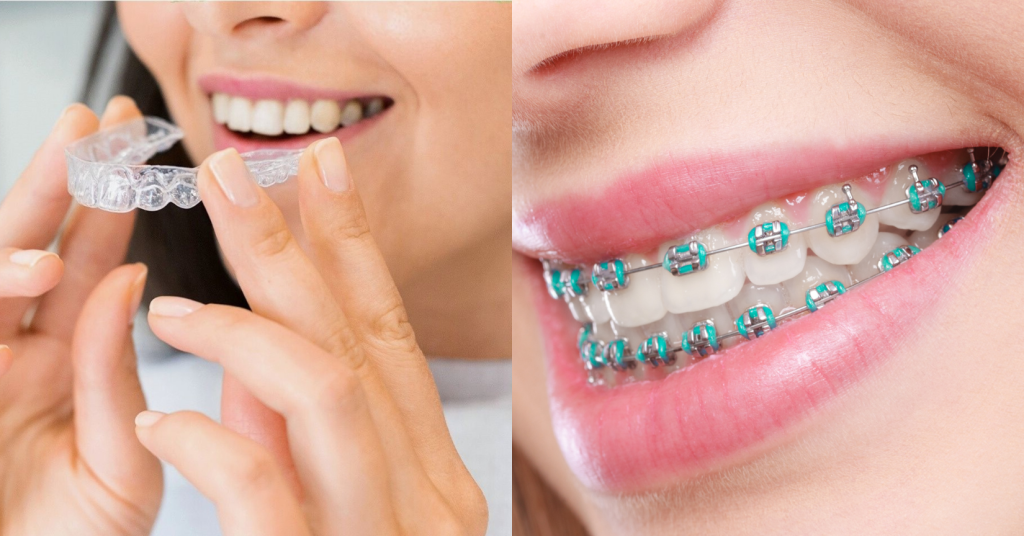
If you’ve finally decided to do something about that crooked tooth, gappy smile or stubborn overbite that’s been bothering you for years, congratulations, that’s the hardest bit. The next question is the one most adults get stuck on: Invisalign or traditional braces?
Both work, and can give you a beautiful, straight smile. But they do it in different ways, and the right choice depends on your case, your lifestyle and what you’re prepared to live with for the months ahead.
This guide will walk you through visibility, comfort, treatment time, lifestyle fit, and the cases where each genuinely is the better answer.
Quick comparison briefly
|
|
Invisalign |
Traditional braces |
| Appearance | Nearly invisible | Visible metal (or tooth-coloured ceramic) |
| Removable | Yes. For eating, brushing, photos | No. Fixed for the duration |
| Comfort | Smooth plastic, no wires | Brackets and wires can rub |
| Eating | Eat anything (aligners come out) | Restrictions on hard, sticky, chewy foods |
| Best for | Mild to moderate cases; lifestyle-conscious adults | More complex bite issues; severe rotations |
| Compliance required | High. Must be worn most of the day and night | Low. They’re fixed in |
Below, we go through each of these in detail and explain when one genuinely outperforms the other.
1. Visibility and aesthetics
For most adults, this is the deal-breaker.
Traditional braces have come a long way from the chunky metal “train tracks” of the 1990s. Modern brackets are smaller, and ceramic (tooth-coloured) options blend in better than the old stainless steel.
But however discreet they get; they’re still visibly fixed to your teeth for the entire treatment, which can feel awkward for adults in client-facing roles, on camera, or anyone who’d rather not announce that they’re having orthodontic work.
Invisalign uses a series of clear, removable plastic aligners that fit snugly over your teeth. From a normal conversational distance, most people genuinely won’t notice. You can take them out for an important meeting, a wedding photo or a job interview without anyone being the wiser.
Verdict: if discretion matters to you, and for most adults it does, Invisalign wins this round comfortably.
2. Comfort
Both treatments cause some discomfort. That’s the point, your teeth are being moved.
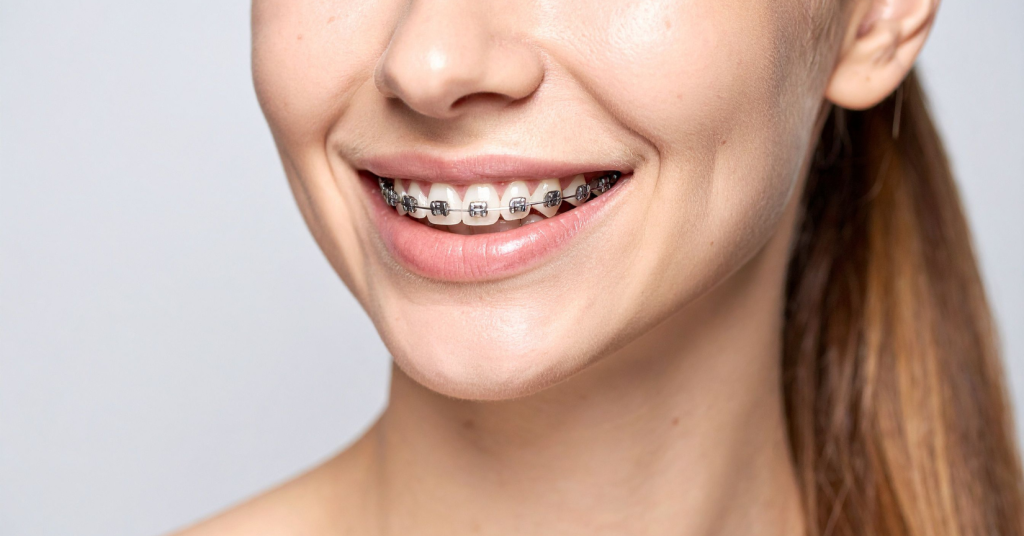
Traditional braces apply continuous pressure through metal brackets bonded to each tooth, connected by a wire.
Most patients describe soreness for a few days after each adjustment, and the brackets and wires can rub against the inside of your cheeks and lips, particularly in the first few weeks. Dental wax helps, but it’s part of life with fixed braces.
Invisalign applies pressure through smooth plastic trays. You may feel mild pressure for the first few days when switching to a new set of aligners; that’s a sign your teeth are moving as planned.
But there’s no metal or wires to irritate the soft tissue inside your mouth. Most patients adapt within a few days.
Verdict: Invisalign is generally more comfortable for adults, particularly anyone with sensitive cheeks or a history of mouth ulcers.
3. Treatment time
This one surprise people.
Most Invisalign cases at Dental Logic Truro complete within 6 to 18 months, many in less than 12 months. Minor adjustments can take just a few months; more complex cases may take longer.
Traditional braces typically run a bit longer than Invisalign for similar cases, though this varies depending on what’s being corrected. The fact that they’re fixed in place means they work continuously, and there’s no risk of you “forgetting” to wear them.
But here’s the catch: Invisalign only works if you wear the aligners for the recommended hours each day, essentially everything except eating, drinking anything other than cool water, and brushing your teeth.
Take them out too often, and treatment will drag on. With braces, the compliance issue doesn’t exist, they’re fixed on whether you remember them or not.
Verdict: Invisalign is usually faster if you’re disciplined. Braces are slower but require zero willpower.
4. Pricing Consideration
We’ve covered Invisalign cost in detail in our 2026 Invisalign price guide, but here’s the short version: Invisalign at Dental Logic typically ranges from £2,800 to £5,000, depending on case complexity and treatment length.
Traditional brace pricing varies even more widely between practices, and depends on whether you’re choosing standard metal brackets, ceramic (tooth-coloured) brackets, or lingual braces hidden behind the teeth. The most accurate way to compare is to get a clear, itemised quote for each.
Verdict: for most adults, lifestyle and aesthetics matter more than the gap in price. Get a clear, itemised quote and choose based on the right fit.
5. Lifestyle fit: work, sport, social life
This is where Invisalign genuinely earns its place for a lot of our patients.
At work
Invisalign is barely visible in meetings, presentations or on camera. Braces are immediately obvious in close-up conversation. For anyone in a client-facing or public-facing role, that matters.
Eating and drinking
Invisalign comes out for meals, you can eat absolutely anything you like, then pop the aligners back in. Traditional braces mean a long list of foods to avoid anything hard (apples, raw carrots, crusty bread), sticky (toffees, chewing gum) or chewy enough to bend a wire. Pizza crusts, popcorn, and corn on the cob are off the menu for the duration.

Sport
If you play contact sports, rugby, football, hockey, traditional braces carry a real risk of cutting your lips on impact. Mouthguards help but aren’t perfect. Invisalign can be removed before the game and put back in afterwards. It’s a clear win for active adults.
Social occasions
Invisalign comes out for the special moments and goes back in afterwards. There’s no reasonable equivalent with fixed braces.
Verdict: if your work, sport or social life are meaningfully affected by visible fixed brackets, Invisalign is almost always the better fit.
6. Maintenance and oral hygiene
This is where Invisalign quietly pulls further ahead.
With traditional braces, brushing and flossing get harder. Food traps around brackets, plaque builds up at the bracket edges, and many patients finish treatment with a row of perfectly straight teeth and visible white “demineralisation” marks where the brackets used to sit.
Special interdental brushes, threaders for floss and water flossers all help, but you have to use them consistently for treatment services.
With Invisalign, you take the aligners out, brush and floss your teeth normally, clean the aligners separately, and put them back in. Oral hygiene during treatment is genuinely no harder than it was before.
Verdict: Invisalign is significantly easier to keep clean and far less likely to cause hygiene-related issues during treatment.
When traditional braces are genuinely the right answer
There are cases where traditional braces still outperform, and any honest cosmetic dentist will tell you that.
You may be better suited to fixed braces if:
- Your case involves severe bite problems (significant overbites, underbites or crossbites that need substantial correction).
- You have multiple severely rotated teeth or teeth that need complex movement aligners may struggle with.
- You have shortened or unusually shaped teeth that aligners may struggle to grip.
- You know you wouldn’t keep aligned in for the recommended hours every day.
Invisalign is well-suited to common orthodontic concerns including crowding, spacing between teeth, mild to moderate bite discrepancies, and teeth that have shifted following previous orthodontic treatment. You would be surprised that often a complex-looking case is actually straightforward with clear aligners.
For most adult cases we see in Cornwall, it’s a strong fit. For more complex situations, fixed braces may still be the better tool, and we’ll tell you honestly at your consultation.
Frequently Asked Questions
Are clear aligners as effective as metal braces?
For most cases, yes. Modern Invisalign technology can correct a wide range of orthodontic issues that previously needed fixed braces. For very complex bite or jaw problems, fixed braces may still be the better tool, your dentist will tell you honestly.
Can adults still get braces on the NHS?
Almost never. NHS orthodontics is reserved for under-18s with significant clinical need. Adults seeking straightening, with either Invisalign or braces, will need to go private.
Will Invisalign affect my speech?
Some patients have a slight lisp for the first few days as their tongue adapts to the aligners. It almost always settles within a week. Fixed braces can also cause minor temporary speech changes when first fitted.
Can I switch from braces to Invisalign mid-treatment?
In some cases, yes, typically once the most complex movements are complete with fixed braces, the rest can be finished with aligners. We’d discuss this honestly if it became relevant during treatment.
How do I know which one is right for me?
The only reliable way is clinical assessment. A 15-minute consultation with our experienced dentists will give you a clear answer, with no pressure to commit.
Ready to find out which option is right for you?
We offer free, no-commitment consultations to help you weigh up Invisalign vs traditional braces for your specific case. If you wish to have a more in-depth look, we can book a further review where you’ll see your teeth scanned in 3D.
Get a clear treatment plan, and walk away with honest pricing and finance options, whichever route turns out to be best for you.
📞 Call us on 01872 306622
🦷 Or book your free Find Out for Free session online
Dental Logic, 5 Little Castle Street, Truro, Cornwall, TR1 3DL.
You may also want to read: